MAKE A DONATION
Newsletter Email Subscribe
Please leave this field empty

newly diagnosed
In this overwhelming time, the best defense is information. Learning about a child’s specific cancer, its treatments and their side effects will help you prepare for the road ahead.
Parents and Families: Newly Diagnosed
Newly DiagnosedIn TreatmentAfter Treatment

Germ cell tumors

The term "germ cell" refers to-giving of life, as in "germinate" (not from "germs" as in bacteria). Germ cells got their name from the fact that they normally produce the specialized cells that give rise to new life: sperm and egg cells, the sex cells that are needed for human reproduction.

Germ cell tumors are growths that arise in young children and teens, as well as adults. Germ cell tumors are rare, only 2.4 children out of 1 million will develop a germ cell tumor each year. They make up only 4% of all cancers in children and adolescents less than 20 years of age.

 
View Illustration
 

Germ cell tumors most commonly appear in the gonads (sex organs). However, these tumors can arise in several different places within the body:

  • The testes (boys)
  • The ovaries (girls)
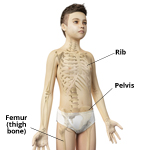
  • The abdomen and pelvis
  • The mediastinum (part of the chest between the breastplate and the spinal column)
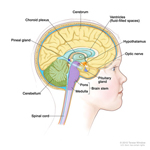
  • The brain

Germ cells develop early in life. At about four weeks, the earliest germ cells in the growing fetus migrate from their point of origin to the gonadal area. But germ cells do not always reach their intended destination, and germ cell tumors can occur wherever these cells end up.

Germ cell tumors can be malignant (life-threatening) or benign (not life-threatening).

Malignant germ cell tumors include several types of cancer, such as immature teratoma, yolk sac tumor and choriocarcinoma. They can destroy the testes or ovaries and can spread to other parts of the body.

Benign germ cell tumors include certain kinds of teratomas. A teratoma is a tumor that may contain several different types of tissue, such as hair, muscle, and bone. Although not as difficult to deal with as malignant tumors, benign germ cell tumors can cause problems because of their size. They can be quite large, even in a newborn.

What causes germ cell tumors?

The exact cause of germ cell tumors is not completely understood. However, these tumors seem to arise when cells which normally migrate to the gonads in the developing embryo fail to reach the right location. Some tumors arise in children with extra genetic material or more than the normal number of chromosomes in all body cells.

What are the symptoms of germ cell tumors?

The signs and symptoms of germ cell tumors differ depending on where they begin:

  • Testicular germ cell tumors (the testes): These are commonly seen as a painless mass in the scrotum (the skin that holds the testicles). In small boys, tumors here may be noticed by the parents. In teen-aged boys, testicular tumors may be more difficult to detect if parents and teens are uncomfortable discussing such intimate matters.

  • Ovarian and abdominal tumors: There may be abdominal pain or constipation. As a tumor gets bigger, it may become evident as an abdominal mass.

  • Mediastinal tumors: These tumors can grow without symptoms until they become quite large. They can cause shortness of breath and wheezing.

  • Sacrococcygeal teratomas: These tumors may be found as a mass that protrudes from the area around the anus. They usually are diagnosed in newborns.

What are the prognostic factors for germ cell tumors?

Many factors go into the decision about how best to evaluate and treat germ cell tumors. Many factors will also affect the outlook for a good outcome.

  • Location: The likelihood of a cure can vary with the location of the tumor. Germ cell tumors of the gonads have a better prognosis than germ cell tumors outside the gonads ("extragonadal"). Mediastinal germ cell tumors are usually silent when small and therefore more difficult to treat.
  • The cell characteristics: Benign teratomas have an excellent prognosis with surgery. Malignant tumors include immature teratomas and other germ cell tumors containing malignant cells. These malignant types include:
    • Endodermal sinus tumors (yolk sac tumor)
    • Embryonal carcinoma
    • Dysgerminoma
    • Seminoma
    • Choriocarcinoma
    It is usually necessary to use surgery and chemotherapy to treat malignant tumors.

  • Tumor cell markers: Many tumors produce proteins that can be measured in the blood over time to show the rate of tumor growth and the success of treatment. Two proteins that can be used as markers are:
    • Alpha-fetoprotein (AFP)
    • Beta human chorionic gonadotropin (bhCG)
    The rate at which these markers fall after surgery or chemotherapy, even if thay are high at the outset, is becoming recognized as a prognostic factor (a way to predict how quickly or successfully a tumor will be to treat)

  • Stage: Patients whose tumor has spread from its point of origin to other parts of the body require more therapy and may have a poorer outcome.
  • Age of diagnosis: Patients older than 15 years of age have a poorer outcome than younger patients.
Thomas Olson, MD, Children's Healthcare of Atlanta, Emory University
Reviewed and edited by the CureSearch.org Medical Editorial Board May 2006